
“East of Eden” - Theme Study
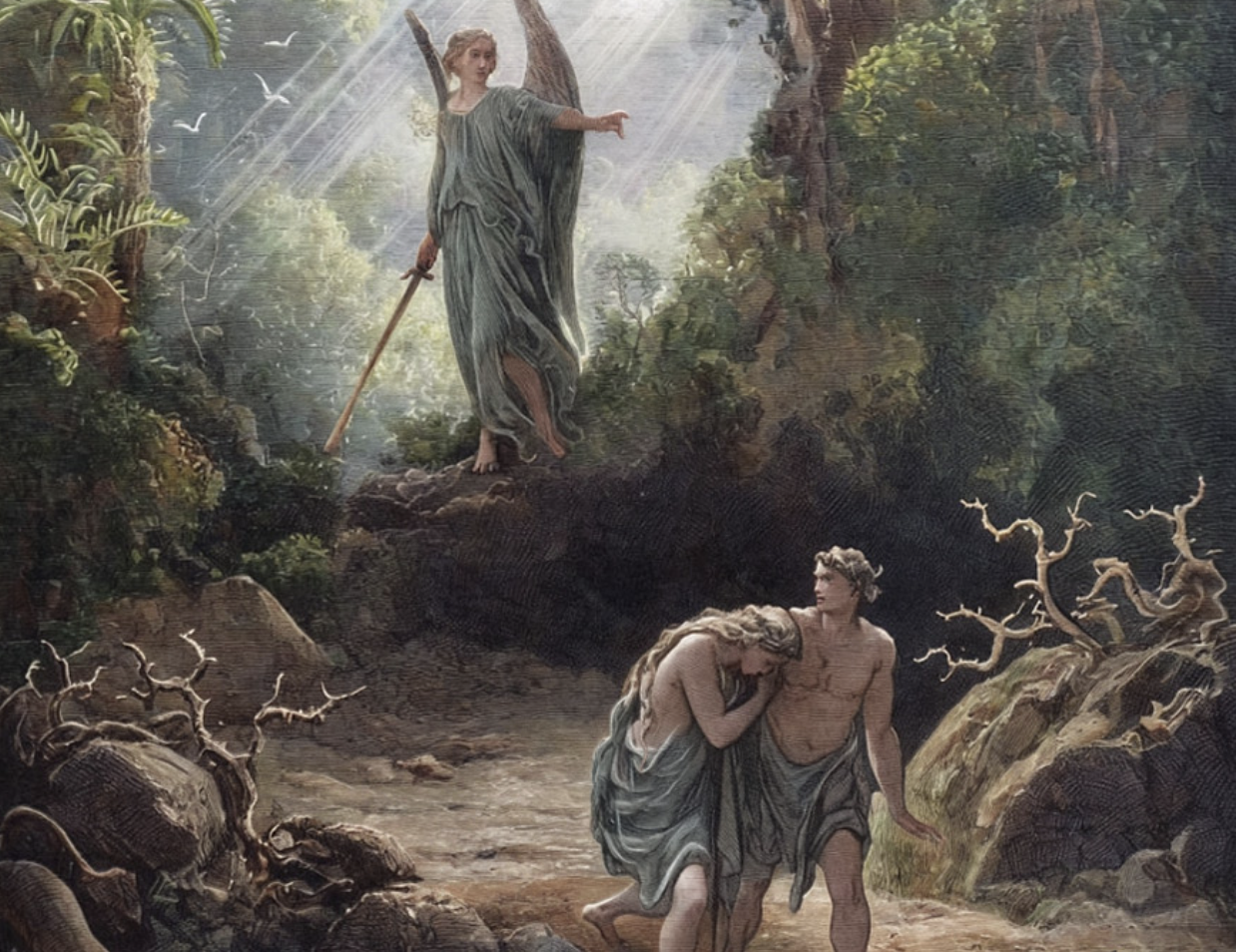
Adam and Eve Are Driven out of Eden (colorized), Gustave Dore 1866.
By Stephen Cooksey // CBT
In The Lord of the Rings, when Frodo’s sword Sting glows blue, what comes to your mind?
Well, if you’ve read the book or seen Peter Jackson’s adaptation, you know that it means orcs are nearby and that Frodo needs to run…like right now!
What comes to mind when you hear the Imperial March play in the Star Wars universe?
“Dun dun dun, dun da dun, dun da dun”
Even casual fans know that Darth Vader and/or his stormtroopers are arriving on the scene.
These visual and auditory cues are well known to many of us and have trained us to react a certain way when we encounter them during our movie nights.
What if I told you the Bible has its own version of Frodo’s sword or Darth Vader’s song?
What if the literary construction of the Bible uses similar storytelling devices that modern movie franchises employ today?
One good example lies east of Eden…and no, not John Steinbeck's novel.
The phrase “east of Eden” is found in Genesis 4:16:
“Then Cain went away from the presence of the Lord and settled in the land of Nod, east of Eden” (ESV).
This verse concludes the story of Cain killing his brother Abel.
But why does the narrator of Genesis choose the words “east of Eden?”
Why does the author care that we understand the geography of his journey?
The answer lies in understanding the Bible’s use of literary cues. Often called “Repeated Key Words” or “Leitwörter.”
In Genesis, east is where Cain wanders when he is cast out from the presence of the Lord.
And even earlier in the story, east is the direction that Adam and Eve leave the Garden of Eden.
“He drove out the man, and at the east of the garden of Eden he placed cherubim and a flaming sword”(Genesis 3:24a, ESV).
So it would seem from these two closely related passages that…
The east is associated with being voluntarily outside God's will.
Fast forward to Jonah…
After Jonah survives the belly of the great fish and preaches to the Ninevites, he has an epic crash-out when God decides not to destroy the city of Nineveh (Jonah 4:1-3).
Jonah is angry and spiteful. But God simply replies:
“‘Do you do well to be angry?’” (Jonah 4:4b, ESV)
What Jonah does next should remind us of something.
“Jonah went out of the city and sat to the east of the city and made a booth for himself there” (Jonah 4:5a, ESV).
In Jonah’s rebellion, the Bible says he went east.
The literary clue should resonate with any attentive reader.
East is linked with being outside of the will of God.
This literary clue is found throughout the Bible’s narrative.
Lot chooses to go east toward Sodom. Away from Abraham and the promised land (Genesis 13:11).
The Israelites had to turn their back to the east to enter the Tabernacle (Exodus 27:13-16)
Gideon has to fight an army of “people from the east” to free the people of God (Judges 6:3)
Ezekiel has a vision where the Israelite priests turn their backs on the Temple and face east to worship the sun (Ezekiel 8:16)
In all these biblical narratives, the east becomes a literary clue to what is going on in the characters’ hearts.
Much like Frodo’s sword and Darth Vader’s song, East in the Bible holds a covert meaning to attentive viewers.
In a cinematic translation of the Bible, this theme would be transposed right from the text to the screen.
Imagine Adam and Eve stumbling, distraught and afraid, into the rising sun.
Picture Cain dominating the screen as he turns his back against a beautiful sunset.
Envision Jonah shielding his eyes from the intense heat of the morning sun as he leaves Nineveh to its fate.
