
What Do Wild Animal Attacks Tell Us About Jesus?
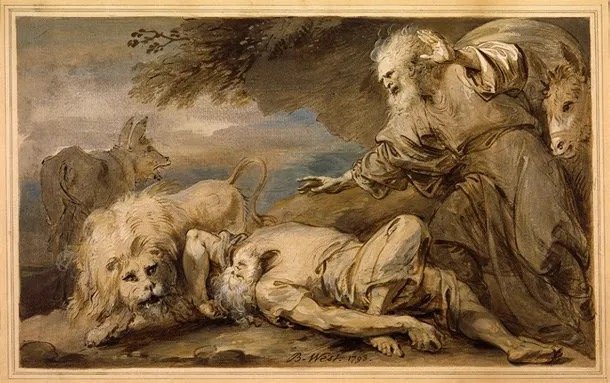
The Disobedient Prophet, by Benjamin West.
By Stephen Cooksey // CBT
Imagine you're directing a movie based on the Gospel of Mark.
The camera opens on a barren wilderness.
The wind howls.
Jesus, the hero, has just endured a confrontation with Satan.
We expect action. We expect dialogue. We expect some dramatic showdown.
Instead, Mark gives us an odd detail.
"He was in the wilderness forty days, being tempted by Satan. He was with the wild animals…" (Mark 1:13a, ESV).
Wait. Wild animals?
If this were a Hollywood screenplay, an editor might cut that line immediately.
It seems random.
Matthew and Luke tell a much longer version of Jesus's temptation and never mention the animals.
Why does Mark include this detail?
The answer reveals one of the Bible's most cinematic storytelling techniques, and it teaches us how mere adaptations of the biblical stories often fall short.
The Bible Loves Visual Callbacks
Think about your favorite films.
When Steven Spielberg shows a shark fin in the distance, you don't need someone to explain what it means.
When Marvel flashes Captain America's shield on screen, audiences instantly connect it to a larger story.
Filmmakers often communicate through visual cues that point viewers back to earlier scenes.
The Bible does the same thing!
Mark isn't merely telling us where Jesus was for historical precision. He's dropping a subtle clue that points viewers back into the Old Testament.
The wild animals are not background scenery. They're part of the story.
The Problem with Wild Animals
When most people think of Bible stories involving animals, they picture Noah's ark or Daniel in the lions' den.
But throughout the Old Testament, wild animals are often associated with judgment.
Consider some examples:
A lion kills the prophet who disobeys God's commands after confronting Jeroboam (1 Kings 13).
Two bears attack a group of young men who mock Elisha (2 Kings 2).
Lions, bears, wolves, and other predators repeatedly appear as instruments of divine judgment (Jeremiah 5, 2 Kings 2).
These aren't isolated incidents.
They're connected to a larger biblical pattern.
In Leviticus 26, God warns Israel that covenant disobedience will result in curses:
"I will let loose wild animals against you, and they shall bereave you of your children and destroy your livestock" (Lev. 26:22, ESV).
Wild animal attacks are not random tragedies in the bible.
They symbolize something bigger: mankind’s failure to rule creation well.
Going Back to the First Scene
In Genesis 1, God creates humanity and gives Adam a royal commission to have dominion over the animals on earth. This command is intensified in Genesis 2 when Adam names all the animals that God brings to him.
In this beginning narrative, Adam, the first human, is created to be God's representative to rule his good creation.
But after the Fall in Genesis 3, everything changes.
Instead of ruling the animals well, humans fear them - especially the wild animals.
Instead of exercising dominion over them, they are often dominated by them.
Every biblical account of humans being overpowered by wild beasts can remind readers that something has gone terribly wrong with world God originally created.
Now Picture Mark's Scene Again
Jesus enters the wilderness.
Satan is present.
It feels hostile.
This should be a major confrontation narrative between Jesus and Satan.
Instead, Mark quietly moves past a possible temptation narrative and simply tells us:
"He was with the wild animals."
Notice what Mark does not say.
He doesn't say the animals attacked Jesus.
He doesn't say they threatened him.
He doesn't say he fled from them.
Jesus simply exists among them.
It's a remarkably subtle image.
While Adam failed in a garden, Jesus succeeds in a wilderness.
While humanity failed to uphold their royal calling of ruling over creation, Jesus embodies it perfectly.
Mark's tiny detail functions like a carefully placed shot in a movie.
For just a moment, the camera lingers on the wild animals, and attentive viewers realize something profound:
The New Adam has arrived.
The King of Creation has quietly come.
Jesus as the Hero of the Story
Once you see this pattern, you start noticing it throughout the Gospels.
Jesus commands storms.
He provides fish.
He multiplies bread.
He walks on water.
He casts out demons.
Creation is under his dominion.
The natural world recognizes Jesus’ authority in a way rebellious humanity often does not.
In the wilderness, Mark gives us an early preview of everything that follows.
Like a trailer before the feature film.
A brief scene that hints at the larger story.
What We Can Learn As Biblical Filmmakers
One of the biggest mistakes modern adaptations make is focusing only on the surface action of biblical stories.
The Bible's best moments often happen beneath the surface - something a cinematic translation can capture.
Imagine filming Mark 1.
You could simply show Jesus standing in a desert.
Or you could frame him calmly surrounded by untamed creatures, or wolves watching from a distance, a lion resting nearby, birds circling overhead.
No explanation. No narration. Just imagery.
And very often, that's how biblical storytelling works.
The Bible frequently communicates through recurring images, patterns, and echoes rather than explicit explanations.
In my opinion, the best biblical films don't merely recreate events or add additional characters to their screenplay. Instead, they visualize the deeper themes that already exist within the Bible, thereby tying Scripture together.
The Bigger Picture
Animal attacks throughout the Old Testament seem to highlight humanity's failure to rule God's creation faithfully.
Mark's picture of Jesus among the wild animals reverses that.
The wilderness scene is much more than a passing detail.
It's a visual declaration that Jesus is succeeding where Adam failed.
The King is reclaiming his kingdom.
And like any great filmmaker, Mark tells us all of that with a single unforgettable shot: Jesus living peacefully among the wild animals.
